

Real Estate Media Guide for Better Listings

A listing has a short window to make a strong first impression. Buyers scroll fast, compare faster, and form opinions before they read a single room description. That is why a real estate media guide matters. The quality of the visuals shapes how a property is perceived, how long someone stays on the listing, and whether they decide the home is worth a showing.
Good media does more than make a property look attractive. It sets expectations, highlights value, and gives agents and sellers a cleaner way to market across listing platforms, social media, brochures, and websites. Poor media does the opposite. It can make a well-kept home feel flat, smaller than it is, or simply forgettable.
What a real estate media guide should cover
At its core, a real estate media guide should help you answer one practical question: what visual assets does this property actually need? The answer depends on the price point, the target buyer, the condition of the home, and where the property will be promoted.
For many listings, professional photography is the baseline. Clean, well-composed images are still the foundation of effective property marketing. They show layout, light, finishes, and condition in a way that feels credible and market-ready. But photography alone is not always enough.
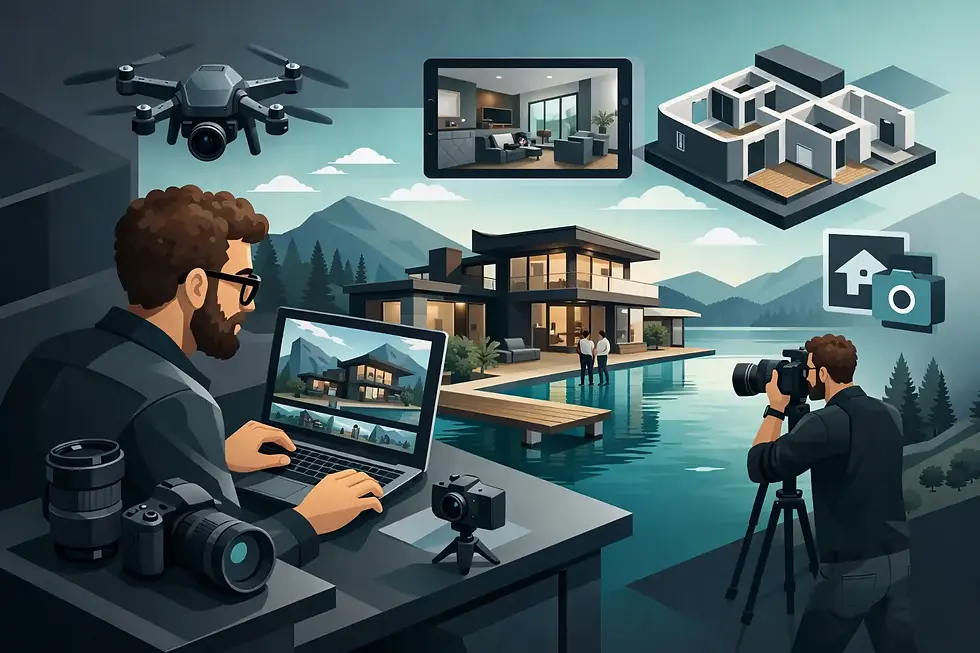
Video becomes more useful when the property has flow, scale, scenery, or lifestyle value that still images cannot fully communicate. A waterfront home, a new development, or a property with strong indoor-outdoor living often benefits from motion. Floor plans add clarity when buyers want to understand room relationships quickly. Drone coverage helps when land, setting, or neighborhood context materially affects value.
The point is not to add every media option to every listing. More content is not automatically better. The right package is the one that supports the property and the sales strategy without adding noise.
Photography still does most of the heavy lifting
The strongest real estate marketing usually starts with photography because it carries the widest workload. Listing portals rely on it. Social posts often begin with it. Print pieces and feature sheets need it. If the photo set is weak, the rest of the campaign has to compensate.
Strong listing photography is not about making a home look dramatic at any cost. It is about presenting the property accurately, cleanly, and attractively. Rooms should feel bright but believable. Vertical lines should be straight. Composition should show purpose, not just space. Buyers need enough context to understand how the home lives.
That means preparation matters as much as the shoot itself. Clutter, personal items, poor lighting, wrinkled bedding, and distracting surfaces all reduce the impact of good photography. Even high-end homes can photograph poorly if the space is not ready.
There is also a trade-off to manage. Over-editing can create images that look polished on first glance but feel misleading in person. Under-editing can make a property seem dull. The best approach is balanced processing that improves clarity and consistency while keeping the home honest.
When more photos help and when they do not
A larger gallery can be useful when the property has multiple selling points, secondary structures, acreage, or meaningful amenities. But padding a gallery with repetitive angles rarely improves performance. Buyers want coverage, not duplication.
A tighter set of well-chosen images often works better than a long sequence of nearly identical shots. Quality of selection matters almost as much as quality of capture.
Video is not mandatory, but it can be decisive
Video is one of the most misunderstood parts of property marketing. Some agents treat it as essential for every listing. Others skip it entirely. In practice, it depends on the property and the campaign.
Video works best when movement adds understanding or emotional pull. A walkthrough can help buyers grasp layout. A cinematic edit can build interest around architectural features, views, amenities, or lifestyle. A short vertical reel can create fast attention on social media. These are not the same product, and they should not be treated as interchangeable.
For an entry-level condo with a straightforward layout, video may not change much if the photography is already strong. For a luxury home, custom build, vacation property, or development project, video can carry much more weight. It helps translate atmosphere, scale, and sequencing in a way stills cannot.
The main mistake is commissioning video without a clear use case. If there is no plan for where it will be published, who it is meant to reach, and what kind of response it should generate, it becomes an expensive extra instead of a working asset.
Floor plans and drone media add clarity
Buyers do not always need more style. Sometimes they need more information. That is where floor plans and drone content earn their place.
Floor plans reduce friction. They help buyers understand how rooms connect, where bedrooms sit in relation to living spaces, and whether the layout suits their needs. This is especially useful for family homes, multi-level properties, and listings where the room sequence is not obvious from photos alone.
Drone imagery is most effective when the setting is a selling feature. Large lots, lakefront access, mountain views, surrounding vineyards, or proximity to amenities can all benefit from aerial perspective. In areas like the Okanagan Valley, where landscape and lifestyle often support property value, drone coverage can provide meaningful context rather than just visual flair.
But drone media should be selective. If the surroundings are ordinary or if aerial views do not add useful information, it may not justify the cost. Like every other asset, it should serve the listing, not the other way around.
Matching media to property type
Not every listing needs the same media plan. A practical real estate media guide should account for property type and marketing objective.
A standard resale home usually needs strong photography, and sometimes a floor plan. A high-end listing may need photography, cinematic video, drone work, twilight images, and short-form social edits. A development or builder project may need repeat visits, staged lifestyle scenes, and a broader asset library that can be used across multiple campaigns. Vacant land may rely more heavily on drone coverage and mapping context than interior visuals.
This is where a specialized media partner becomes more valuable than a generic shooter. The goal is not simply to document the property. It is to build a useful set of assets that supports the listing from first impression through inquiry.
Pre-shoot preparation affects results more than most people expect
Many disappointing shoots are not caused by the camera or the editor. They start before anyone arrives on site. If a home is not prepared, the final media suffers.
The basics are straightforward. Clean surfaces. Open sightlines. Balanced lighting. Fresh linens. Clear counters. Removed cords, bins, magnets, pet items, and excessive personal photos. Exterior prep matters too. Garbage bins, hoses, vehicles, and patchy furniture placement all show up quickly in listing media.
For occupied homes, preparation can also require realistic expectations. Some spaces are hard to shoot well because they are overfurnished, dark, or visually busy. A good media professional can improve a lot, but not everything should be left to post-production.
Clear communication helps here. If a room is a priority, say so. If a feature is newly renovated, point it out. If a view changes at a specific time of day, schedule around it. Better planning almost always produces better marketing.
Choosing the right media provider
A polished portfolio matters, but it is not the only thing that matters. Reliability, consistency, turnaround time, communication, and understanding of property marketing are just as important. Agents and sellers need media that is delivered on time, organized properly, and ready for use without unnecessary back-and-forth.
Ask practical questions. Does the provider understand listing strategy, not just image-making? Can they advise on what is worth filming and what is not? Are edits consistent across different property types? Do they produce work that looks good and functions well as sales media?
That commercial awareness is what separates attractive content from useful content. Maurer Media, for example, positions its real estate work around clean, professional visuals that are built for market use, not just visual impact.
The best media feels intentional
Buyers can tell when a listing has been assembled with care. They may not describe it that way, but they feel it. The photos make sense. The video supports the story. The floor plan answers questions. Nothing feels random or excessive.
That is the real value of a strong media plan. It gives the property a more confident presentation and gives the seller or agent a better toolset to compete. Some listings need a simple approach. Others need a fuller campaign. The difference is not budget alone. It is fit.
If you treat media as part of the sales strategy instead of a box to check, the results are usually stronger from the first click onward.


Comments